Victorian era
H is for HawkThe Victorian era enters the book chiefly as a remembered and written tradition of falconry, rather than as a continuous account of the period. Victorian falconers’ descriptions of goshawks and the later image of privileged sporting culture become evidence through which Helen examines class, gender, and the stories people tell about birds.
Falconry and social distinction
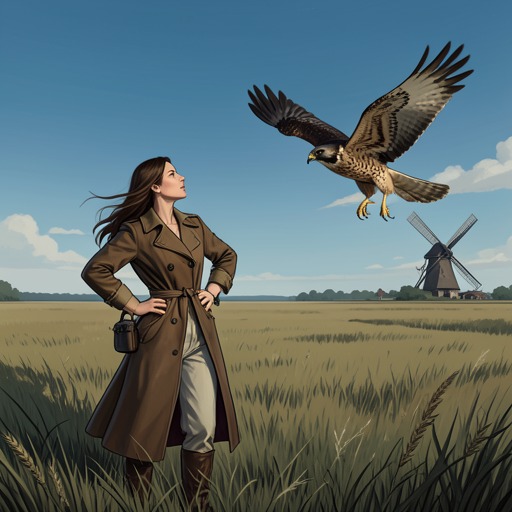
Helen’s childhood image of falconry includes Victorian falconers in tweed, whose sport seems to place death within an established world of ceremony and confidence. Looking back, she connects that image to social privilege: the experience appeared to belong to people who could treat hunting as an assured inheritance rather than a contested use of land and resources.
The book places this association within a longer history of unequal access. Properly flying falcons required broad open country, such as grouse moors, partridge estates, and extensive farmland—opportunities more readily available to the wealthy or well connected. Goshawk hunting, by contrast, could take place in more varied surroundings. This contrast helps explain why accounts of falconry could elevate falconry with falcons as an aristocratic pursuit while casting the solitary goshawk trainer as socially inferior.
Victorian writing about goshawks
Victorian falconry books repeatedly characterize the goshawk as disagreeable and difficult. Helen reads Charles Hawkins Fisher alongside other writers who describe the bird’s temper in negative terms. In her account, this tradition makes the goshawk seem inherently troublesome while leaving little room to ask whether a falconer’s conduct contributes to a bird’s fear, agitation, or refusal to return.
The descriptions are gendered as well as moralizing. When a man suggests that Helen and her female goshawk naturally understand one another because they are both female, Helen rejects the idea that their different species share a simple bond of sisterhood. Yet, reading the books, she recognizes a related pattern in older falconry language: female goshawks are portrayed as moody, unreasonable, and difficult to manage. The bird’s behaviour is treated as a defect in its nature rather than considered in relation to how it is handled.
Earlier accounts and changing interpretations
Helen contrasts Victorian judgments with seventeenth-century writing. Simon Latham described goshawks as shy and fearful but also sociable and capable of affection; he connected their response to rough treatment and argued for kindness and consideration. Edmund Bert likewise wrote of friendship between keeper and hawk. These accounts do not make the birds compliant: they present them as self-willed and contradictory, and make the falconer responsible for attending to their needs.
The contrast matters because it turns a supposed change in the goshawk into a question about human interpretation. Helen is persuaded by the earlier writers’ emphasis on care and companionship, while recognizing that their language also reflects their own perspective. Read against those accounts, Victorian descriptions of the bird’s temperament appear less like neutral observation than like judgments that obscure the relationship between a hawk’s behaviour and its treatment.
Historical memory and its limits
Falconry makes the past feel physically close. Helen observes that hawk species remain unchanged across human generations, so holding a trained hawk can create the impression of sharing an encounter with a falconer from centuries earlier. But that sense of continuity can encourage people to imagine that earlier falconers saw the land as they do, and to claim an elevated ancestry for the sport. Gage Earl Freeman’s nineteenth-century celebration of falconry’s high descent exemplifies that appeal to inherited status.
Helen’s account therefore treats the Victorian era both as a historical reference and as a later cultural image: a world recalled through books, class privilege, sporting rituals, and childhood glamour. Her adult understanding is more critical. She no longer trains a hawk to feel connected to distinguished ancestors or to possess a special place in history; the imagined continuity that once lent falconry its allure is something she wishes to escape.